
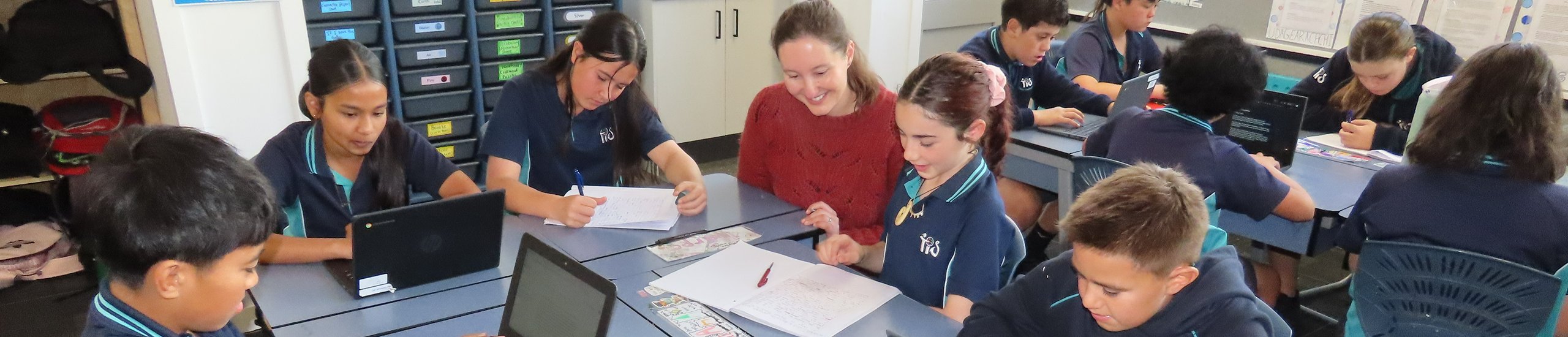
In a rapidly changing world, Tawa Intermediate School prioritises equipping our ākonga with current and future-focused skills through hands-on problem-solving experiences. Students rotate through five specialist subjects (Mātanga) in six-week blocks, with two lessons per week throughout the school year. Our dedicated teachers ensure that every learner—regardless of their prior experience—completes each rotation having gained new skills, a tangible outcome, and a well-deserved sense of pride.
In Mātanga Toi Whaaraki (Performing Arts) students explore the mediums of Music, Dance and Drama, giving students a chance to express themselves in these spaces by creating, engaging and learning together. Ākonga will spend time writing and producing music, performing plays and learning about the conventions of Drama whilst also learning and choreographing dances for these plays. Our purpose is to bring the inside to the outside and have some fun along the way.


In Mātanga Kai (Foods) students will follow the design process and generate potential ideas, get feedback from stakeholders and then refine their concepts and produce an outcome. Students learn to develop appropriate culinary skills and knowledge while also experimenting with different ingredients and techniques. Along with building on their skills and knowledge, students have a strong focus on health and safety within the food space and then get to design, create, and find solutions for food-related problems. The subject of Mātanga Kai focuses on developing creativity and confidence, practical skills, technological vocabulary and independence.
In the Mātanga Pūrau (STEM) programme, ākonga follow the Engineering Design Process to solve real-world, everyday problems. By exploring consumer needs, defining challenges, ideating, testing, and assessing their work, ākonga learn first-hand that mistakes are simply a valuable part of the learning journey. Central to this hands-on technological experience are our brand-new 3D printers, which allow students to bring their iterations and designs to life.
Not sure which image you would like used here. I could not find one that I could identify that fitted well for STEM
Please advise

In Mātanga Hangarau (Makerspace), students use the Design Thinking Process to create a prototype that either meets a need in their home or provides entertainment. Some of the steps in the Design Thinking Process include brainstorming ideas, problem-solving, planning, responding to stakeholder feedback, and assessing our prototype. To enable the creation of the prototype, students learn a range of skills, including how to work safely in a workshop.
In Mātanga Toi (Art) students explore the medium of clay, paint and mixed media in order to express their ideas and refine their outcome along with their understanding of the art world and practise. Students build visual, tactile, and spatial skills through hands-on art-making. They explore materials and techniques. They learn to problem-solve and refine their ideas. Students explore how visual arts connect with cultural, historical, and technological contexts, and how art reflects and shapes societal beliefs, needs, and values. They look at how artistic traditions are maintained or changed and learn about the diverse cultures of Aotearoa New Zealand and beyond. They are encouraged to take risks and experiment with their ideas, expressing their own experiences and feelings through art. Students also work on communicating their artistic intentions and analysing the meanings of visual art. They develop critical thinking skills by evaluating their own work and that of others.

Parents, please support our local businesses








Visit Website

Call Direct

Send Email
Visit Website
Call Direct
Send Email
Visit Website
Call Direct
Send Email
Visit Website
Call Direct
Visit Website
Call Direct
Send Email
Visit Website
Send Email
Visit Website
Call Direct
Send Email
Call Direct
Send Email
Visit Website